After twice experiencing anaphylaxis caused by bee stings, Brian turned to venom immunotherapy
Brian was out riding his bike with his then three-year-old daughter when he felt something sting his leg.
“I thought nothing of it,” he recalls. It wasn’t until about 10 minutes later that he began to feel so unwell he decided to cycle to the nearest hospital.
“I got about halfway when I thought, I’m not going to make it,” he describes. He stopped, took his daughter out of her bike seat and the next thing he knew, he was lying on the ground looking up at paramedics. Fortunately, someone had seen a little girl standing by herself – or so it looked – next to a bike, noticed Brian lying unconscious beside her, and phoned emergency services, who administered adrenaline on the spot.
Brian was taken to hospital for monitoring, where he was told he must be allergic to bees and to see his doctor. That led to a referral to an allergy specialist and a six week wait – during which time Brian, unluckily enough, experienced his second episode of anaphylaxis following another bee sting while bike riding.
This time, Brian knew he was near an ambulance station. He cycled there, walked in and had just enough time to tell the paramedics he’d been stung by a bee before he lost consciousness.
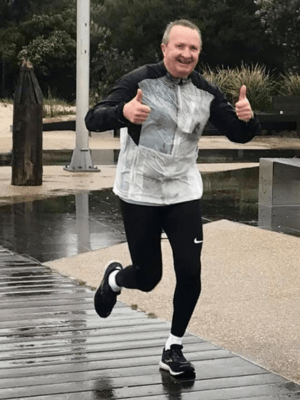
“When I saw the specialist he couldn’t believe I’d been stung twice in four weeks,” Brian says. Testing confirmed Brian’s allergy, and his specialist advised venom immunotherapy (VIT) given the severity of his reactions. He was also prescribed an adrenaline device, which he carries with him to this day, including when he’s out cycling or running.
Venom Immunotherapy

Over a five-day period Brian began VIT (also known as desensitisation) at The Alfred Hospital in Melbourne (please note VIT protocols vary between hospitals). “I think I had about eight injections on the first day” he remembers. “Followed by six injections on the second day, then four, then two, and on the final day I was given the equivalent of a full bee sting.”
After his time in hospital, the program continued with regular injections administered by Brian’s GP. To this day, he has an injection every six weeks.
Although Brian was warned that VIT wouldn’t completely “cure” his allergy, he is no longer considered at risk of anaphylaxis to bee stings. “I still react, but it’s stopped it from becoming a serious reaction,” Brian explains. He’s been stung a handful of times in the years since he began immunotherapy with no major adverse effects.
Jack Jumper ant allergy
It isn’t just bees Brian is allergic to – he discovered he has a similarly severe reaction to jack jumper ants after they took up residence in his backyard.
“I’ve been bitten a couple of times and now I know what to do straightaway,” Brian says. “I use my EpiPen and call the ambulance, but by the time they get there I’m usually fine,” he says.
Brian investigated desensitisation but the logistics of the program made it difficult to commit to as Jack Jumper ant desensitisation is not available in as many hospitals as bee and wasp.
Instead, he is vigilant about always having an EpiPen® with him – and promptly dealing with any ant nests he spots in the backyard.
Share your story
Being diagnosed or living with allergies is challenging.
We are always grateful for people who take the time to share their stories with us so others don’t feel so alone.